Showing posts with label Bouldering. Show all posts

Monday, January 23, 2012

Brimham Rocks: Bouldering

Brimham Rocks are a collection of boulders and crags near Harrogate in North Yorkshire. The rocks, made of gritstone, have been sculpted by erosion into unusual shapes including rounded towers, loaf shapes, and rocks are balanced in surprising locations.

The grippy nature of the rock, and the shapes it is formed into, make Brimham Rocks a great place to go climbing and bouldering. There are climbing routes up to about 14 metres long across the grades, and a similar range of bouldering problems scattered across the formations. Jamming cracks seem to be a common feature here.

The second weekend of January was blessed with sunny, still conditions - a perfect opportunity to make my first visit to Brimham and try and work off the excesses of christmas.

Sculpted shapes: around Castle Rock at Brimham Rocks

We started by doing some boulder problems and routes on Castle Rock, the most impressive large rock formation at Brimham. Despite the frosty conditions the rock faces in the sun were warm to the touch, making climbing pleasant. Lots of walkers stopped to watch as we soloed some of the easier routes, although some of the parents with young children were not impressed by the example we were setting.


Cubic Block, Brimham
We then tested out a few boulder problems in the Cubic Block area of Brimham. The problem in the photo above goes from a lying down start, at full stretch, into big pull up the arete to the break at the top of the photo. The big pull defeated Neil and I despite repeated attempts. One for next time!

Heather Wall, Brimham
As the sun dropped towards the horizon, the temperature fell rapidly. We kept moving to keep warm, accomplished by soloing some easy routes on Cubic Wall. In the photo above Neil is climbing Heather Wall (severe).

Cubic Corner, Brimham
Neil climbing Cubic Corner (Hard Severe 4b). The route follows the arete on Cubic Block and had a tricky move at about 2/3rds height that gave a touch of excitement to my solo attempt. When the rock became to cold to climb we called it a day. A great start to 2012!


Saturday, October 22, 2011

Almscliff: Leeds local crag


Almscliff

Almscliff, halfway between Leeds and Harrogate, is the most famous of Yorkshire's gritstone crags. It is a huge lump of high quality gritstone perched on top of a small hill, rising up over the flat surrounding landscape. This means that although the crag is small relative to the gritstone edges of the Peak District, it has climbable rock on all sides, which compares favourably with the single climbable aspect of many of the Peak edges. It also means that the crag is very exposed; you will definitely feel the wind on all but the calmest days.

Almscliff west face
On a dry and sunny saturday afternoon in October Almscliff was busy with climbers, walkers and casual visitors. In this photo a handful of walkers look on as a climber starts up Zig Zag, on the West Face.

Many of the climbing routes require good arm stamina - something that often catches out first time visitors to Almscliff (I write from experience). This is because the major faces are steep and much of the crag is undercut at the base, which requires some monkeying around, putting most of your body weight on your arms, to get started on the routes - as can be seen with climber in the photo above.

Great Western area, Almscliff
No climbers were tackling Great Western or the adjacent Crack of Doom, which are two of the most famous routes on the crag, despite the fact that the weather conditions were perfect and both routes were in the sunshine. Great Western goes up the large vertical crack in the middle of the photo, heads left along the break, and then finishes by going up and around the corner to the left. Crack of Doom follows the same vertical crack, then heads out right onto the projecting wall and a quick finish on top of the wall.


Almscliff is also home to lots of great bouldering problems, both on the main crag and on the boulders that are scattered around its base. Many of these problems are described in the Yorkshire Gritstone bouldering guide. The arete shown in the photo above is part of the Virgin group of boulders, and can be climbed with a bouldering grade of font 6a.

Matterhorn boulder
This is the Matterhorn Boulder. The prominent arete was first climbed over 100 years ago by Claude Benson. Today, the climb up the arete is worth font 4+; easy by modern standards.

The Crucifix, Almscliff
The distinctive cross-shaped pair of cracks can be climbed as a problem called The Crucifix. It is worth a grade of font 5. It is a long way to fall from the top of the vertical crack - padded mats and someone to spot you would be useful.

The Crucifix is part of the Demon Wall area of Almscliff, which is also home to several hard boulder problems - these tend to terminate 3-4 metres above the ground - and a handful of climbing routes that lead to the top of the crag. Numerous chalk marks on the rock show how popular this area of the crag is.

The location of Almscliff, and the large number of popular climbing routes and bouldering problems there, means that many of the key hand and foot holds are polished, so the famous gritstone friction is often lacking.  This doesn't appear to affect the quality of the routes much (apart from making them a bit harder!). It is certainly worth visiting Almscliff as an occasional treat, however, rather than an as a regular practice crag, to minimise further damage.


Wednesday, June 29, 2011

Caley bouldering

It was a beautiful evening; sunny, clear, but still cool and with a slight breeze. These are good conditions for bouldering, where the aim is to climb short 'problems' on cliffs and boulders, using a crash mat to land on when you fall. 20 minutes north of Leeds, outside the town of Otley, is  Caley - a popular bouldering venue that has lots of problems described in guidebooks. After finishing work I headed to Caley for the evening.
Oak tree, Caley
Caley is a wooded hillside that has gritstone boulders and small cliffs scattered across it. In the woods there were foxgloves and bilberries covering the ground (along with the ubiquitous bracken), and the trees were predominantly birch and oak, with a few other species mixed in. Some of the oaks, like the one in this photo, had the space to grow broad, spreading canopies that give an ancient woodland feel.
Flapjack boulder, Caley
Among the trees I found my first boulder. It was The Flapjack, which was a good boulder to get started on; it had some easy problems - in the font 3+-5+ range, and it was not very high, so I would not fall far. Judging by the chalk marks, plenty of people have had the same idea.
Cream eggs boulders, Caley
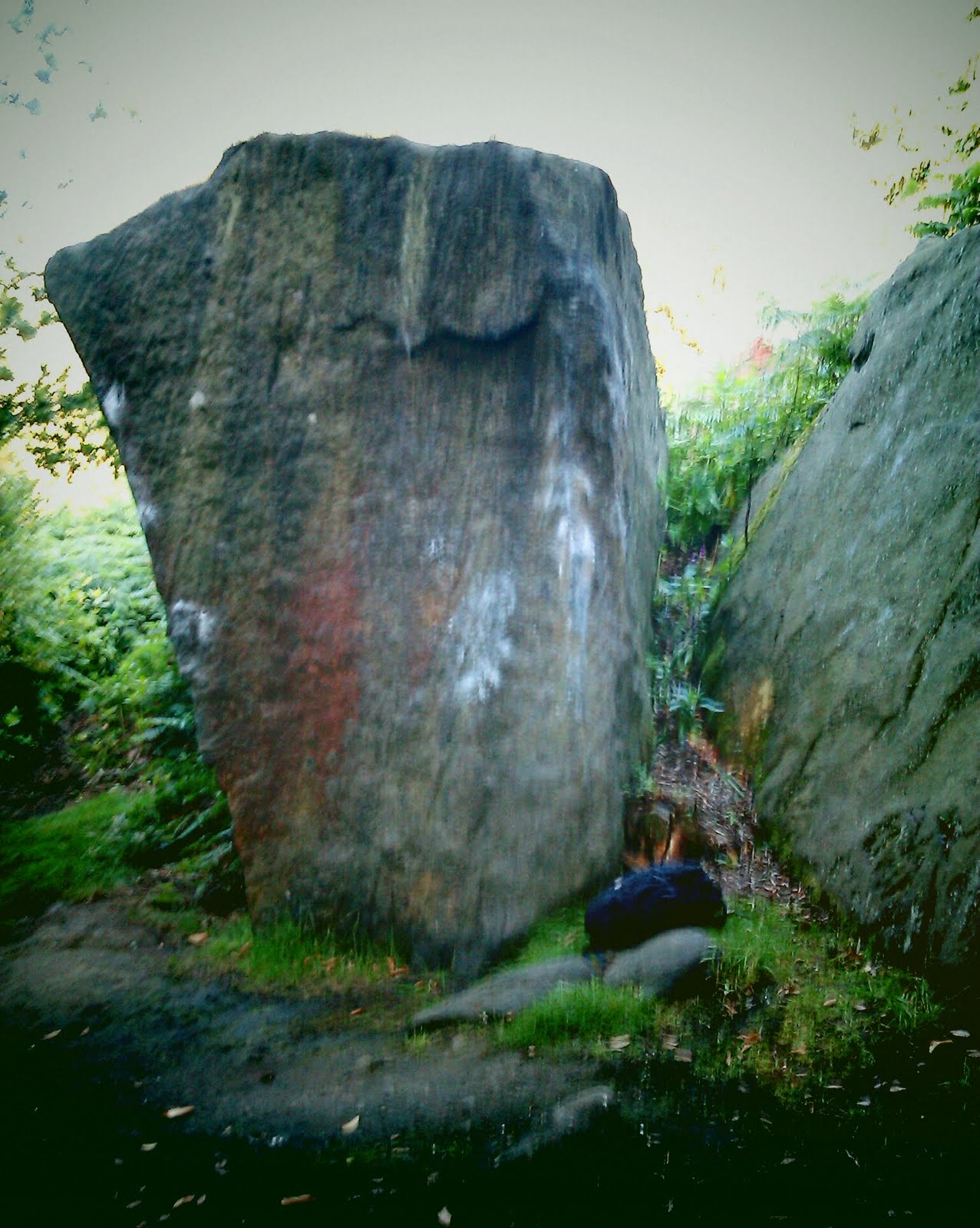
Next, The Cream Eggs. This is a pair of steeper boulders with smooth sides and sharp corners that provide some challenging problems. I repeatedly fell off the chalky corner that has my bag underneath in the photo above, eventually admitting defeat. The corner has a grade of font 6a+.
The Chicken Run boulder, Caley
 Breaking from the snack theme, this boulder is The Chicken Run. It had some short, fun problems that I finished the evening on.The problem that goes up the corner of The Chicken Run is one of the few easier problems at Caley that has been given a name - it is called Cold Turkey - and has a grade of font 5+.
Almscliff
Nursing sore fingers and ready for dinner, I set off home. I emerged from the woodland to blue skies and views across the valley. The small hill on horizon is Almscliff, a famous Yorkshire climbing and bouldering venue.